Central European refugee crisis
The Glass RoomThe Central European refugee crisis transforms political upheaval into a practical struggle over movement, shelter, and family integrity. Refugees arrive in Město carrying what they can, and the public appeal to help them brings the crisis into the Glass Room of Landauer House. Later, at a railway border check, paperwork becomes a matter of whether Katalin and Marika can remain with the Landauer family or be taken away. Across these scenes, the crisis exposes the distance between a document’s formal validity and a displaced person’s actual security.
Displacement Reaches Město
The arrivals follow the first signs of political rupture like a storm breaking over the city. Men, women, and children cross the southern border from Vienna and other cities. Some travel by train or car; others walk, pushing handcarts and carrying suitcases. The narration gathers them into a citywide image of human displacement: people appear in streets and alleyways, at doors and on corners, seeking any place where they might settle. Their presence makes the refugee emergency impossible to keep at the distance of newspaper reports.
The crisis also unsettles Viktor Landauer’s faith in legal and political order. He paces the Glass Room with a newspaper and invokes the treaties of Versailles and St Germain, insisting that the new actions are illegal while recognizing how powerless that objection sounds. His question about what might happen next gives way to an immediate obligation: the family’s spacious room, which might shelter people, instead stands as a reproach because the refugees cannot enter it and unroll their blankets there.
Relief, Witness, and Public Responsibility
Viktor urges Liesel to help, while she initially treats the emergency as a problem for governments rather than individuals. He answers that individuals must press governments to act. Their disagreement gives the crisis a domestic as well as a public dimension: the question is not only what the state should do, but what people with space and resources owe those arriving without them.
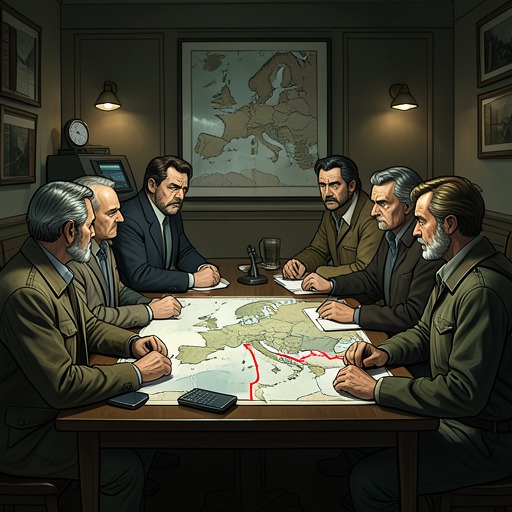
At a committee meeting, the chairman names the concrete needs behind the appeal: shelter, food, schooling for displaced children, medical treatment for the sick, care for the elderly, and money. The meeting is intended to bring the refugees’ personal experience closer to its audience, moving it out of newspapers and newsreels and into the listeners’ own lives. The committee’s plan to introduce witnesses makes visible both the urgency of public testimony and the difficulty of turning suffering into a persuasive appeal.
When the refugees enter the Glass Room, the architecture seems to change function. The room becomes like a small theatre, with no raised stage or proscenium to separate performers from spectators. A secretary directs three adults and three children into place, and the newcomers obey uncertainly before an audience at close range. One family consists of a middle-aged couple, a ten-year-old boy, and a fifteen-year-old girl whose spectacles have a cracked lens. The other is a woman and her young daughter, dressed in a shabby floral dress. The intimate arrangement makes the refugees present as particular people, but it also exposes them to the audience’s gaze as part of an organized appeal.
Kata is among the people brought into the room. Her presence connects the public crisis to Viktor’s private history, while the refugees’ appearance before him unsettles his ideal of the Glass Room as a perfectly rational composition. The room’s openness cannot itself provide safety: it can frame testimony, but it cannot undo the conditions that forced the witnesses to flee.
Family, Class, and Refugee Status
Katalin’s past makes clear that displacement is not a single event beginning at a border. When Liesel asks about Viktor’s earlier financial help, Katalin explains that she had sometimes been unable to find work, pay rent, secure a place to sleep, or buy clothes for her baby. She refuses to express shame for accepting assistance. Her account gives economic insecurity its own weight: the crisis magnifies vulnerabilities that existed before flight, especially for a mother responsible for a child.
In exile, Katalin and Liesel share ordinary family activities, including visits to the market and trips on the lake with the children. Katalin proves to be a capable swimmer, and Marika and Ottilie become close companions. Their everyday life makes Katalin more than a refugee presented to a committee; she becomes part of the Landauers’ intimate circle. That closeness is also practical. When the family considers leaving, Liesel points out that their nurse, Liba, is engaged and has given notice because her fiancé lives in Prague. Liesel proposes that Katalin, whom she considers a devoted mother, take on a role in the household. The children’s attachments and care arrangements are therefore bound up with the family’s possible escape.
The relationship between the women is not free of difference. Liesel reflects that Katalin does not share the same education, cultural habits, or intellectual interests as some of their friends, even as she values their companionship. The crisis places these unequal backgrounds alongside shared dependency and affection: Katalin needs security and opportunity, while the Landauers rely on her presence in their children’s lives. The refugee emergency thus enters the household through both emotional ties and the everyday work of care.
Border Inspection and Separation
At a later railway inspection, the family’s movement depends on documents and the discretion of uniformed officials. Viktor lays out passports, French transit visas, and a Spanish visa for the group: himself, Liesel, their two children, their nanny, and the nanny’s daughter. The official asks for tickets as well as papers. The careful display of documents offers no guarantee of passage; the inspection turns the family’s journey into an uncertain test.
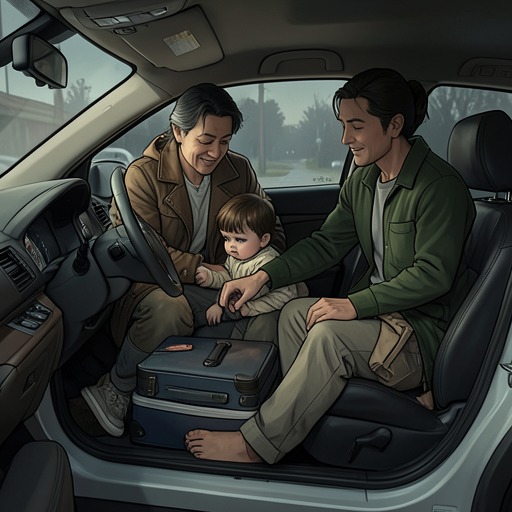
Katalin’s position proves especially precarious. When an official examines her passport and visas, another uniformed figure leads her toward a nearby hut. Marika cries for her mother, and Liesel holds the child close, telling the official that she will look after her. Katalin’s separation from her daughter is not explained by an absence of family bonds: it happens in the middle of a group that has been travelling together and trying to protect both of them.
Viktor protests that Katalin has a refugee passport, specifically a Nansen passport, and argues that the papers had been sufficient for entry into France and Spain. The official threatens detention if he does not return to the train. The crowd’s pressure to move on helps the officials’ command take effect; other passengers fear becoming the next people held back. Katalin and Marika are taken into the hut, their suitcases are removed, and the Landauers are left to wait without knowing what will happen.
Liesel tries to reassure the children that documents can become muddled and that their father will resolve the problem, although she feels no certainty herself. When Viktor argues with an official on the platform, a soldier forces him back toward the train. The family’s attempt to intervene does not restore control over the situation. The crisis’s decisive force lies in that mismatch: papers, legal arguments, and personal loyalties matter, but none can ensure that a family will be allowed to cross together.
The Crisis as a System of Unequal Passage
Across the public meeting and the border encounter, displacement is shown not only as flight from danger but as a struggle for recognition and access. The committee asks listeners to see refugees as people whose needs include food, education, treatment, care, and money. At the station, officials reduce the same human stakes to inspection of passports, visas, and tickets. The contrast is sharp: the meeting tries to make individual lives visible, while border administration decides who may move and who can be removed from a travelling group.
The repeated importance of documents exposes the instability of refugee status. Katalin possesses a Nansen passport and supporting visas, yet Viktor’s claim that those papers have already enabled travel does not prevent her detention. The episode does not present documentation as meaningless; it shows that formal papers remain subject to the decisions of officials and the threat of force. For the Landauers, the crisis is therefore at once a public humanitarian emergency and a private rupture, capable of reaching from a city’s streets into a committee room and from a family’s shared journey to a mother and child held apart.